Sunday, December 4, 2011

I Opened the Wild!

Link up to published version

After hours and hours of winding round bumpy roads we finally turn into one leading to ‘Chaaya Wild Yala’. A security guard at the gate stops the van to reach forward and hand each of us a wooden plank. Now it is important to read what’s written on this wooden block – a warning from the ‘locals’ at Yala about their grunting-trumpeting habits and their penchant for wandering in the dark – so you don’t find yourself surprised to discover that stepping into Chaaya Wild you have, in fact, stepped into the wild.

At the risk of being called cliché and unoriginal, one must admit, the word to describe Channa Daswatte’s work at what used to be Yala Village, is “natural”. The steel, wood, cane and cloth interiors at the entrance and lounge give one only sullen greys, deep browns and subdued greens to rest eyes upon – a welcome sight after a tiring journey to the south-eastern ends of Sri Lanka. There are no fancy works of art for one to stress over sounding educated on and no glaring colours to offend, only homemade ginger-beer or chilled cucumber juice, and as one relaxes and leans against the cloth-backed chairs, the hidden brilliance of Ena de Silva’s batiks on the ceiling. There is only one thing that really demands attention at Chaaya Wild. The cement floors seem to flow through the open boundaries, past the deep green and glittering pool, on towards the unknown jungle.

The lone baby-monitor sunbathing beside the pool, the camouflaged lizard scuttling across the footpath are signs of greater things to come – Grey Langur monkeys swinging outside your window, peeking in from the heat of the midday sun at the coolness of the earthy yet luxurious chalets, the inquisitive squirrel chirruping as it timidly enters to take in the canopied bed with the palmyrah-weave accents, the grunts and squeals of young wild boar as they frolic beneath your wooden floors and the occasional hushed crunch of measured footsteps as an elephant strolls across the quiet neighbourhood.

The chalets are shielded by rattan shades that fall across the many windows which keep the rooms well lit and ventilated. Once the blinds are pulled down and the aircon switched on, only an elephant in your space could bring you out of the lovely cocoon the chalet becomes – perfect for a siesta after an early-begun morning of traversing the conservation grounds.

Safari’s at Yala are like nowhere else in the world. Take it from the experts. Thomas Stephens, producer of Night Stalkers for Nat Geo Wild, 2011 calls Yala’s leopard population “one of the most visible” in the world. Jonathan and Angela Scott, from BBC’s Big Cat Diary, are in raptures about Sri Lanka, the “hidden treasure” for wildlife enthusiasts. Andrew Chastney, film editor for Animal Planet and Big Cat Diary etc., is “absolutely blown away” by his Yala experience. At a presentation made to coincide with the launch of Chaaya Wild, Chastney shared of his experience at Yala, noting that it is rare to see relaxed leopards, and that he “can’t wait to be coming back” to the “best place to find leopards”. During his stay in here, he worked with the Nature Trails team, producing a documentary on the Sri Lankan leopard. This unique experience has given the Nature Trails team at Chaaya Wild the kind of expertise not many other Sri Lankan naturalists can boast, of having worked with one of the world’s leading anima
l experts and some of the most advanced infrared imaging technology.

Head of Eco Tourism for John Keells, Chitral Jayatilake, is keen on making similar equipment part of the Chaaya Wild experience, with the mini night safaris. “Sure we offer luxury to our guests, but we’re mostly about nature” he explains, “if you want to see the leopard, we’ll show you the leopard, but you’ve got to sit it out.” Alongside the typical touristy wild-life activities they offer, Chaaya Wild also has fun activities like animal track identification lessons, camera-trap setting and wildlife movies for the “man-cubs”. But what Nature Trails is gearing to do in the long run is revamp Sri Lankan wildlife culture, getting people serious about observing jungle life, and serious about conservation, because it is, in fact, one of our dearest treasures. “It’s not about quantity or the number of leopards or elephants you see, it’s about quality, about how you see them.” And if you’re lucky, you can even see them while you have a drink.

The architects’ baby at Chaaya Wild is really a wonder. The main open and chilled-out restaurant area is open and relaxing, but not the only option. Management also provides private dining options beside the pool and on the lake shore, as close as you can get to their four-footed and winged neighbours. The part one is not likely to forget easily though, is the Observation Deck. Next to the Peacock Bar, above the restaurant area, is open space. Soft engulfing couches and sleek barstools allow one to be alert or relaxed as one pleases, stargazing while the gentle sea breeze  plays upward from the shores, over the jungle, across the lake and through the candlelight. In the daytime the Observation Deck allows a 360-degree view of the sea, the jungle, the lake, the pool and the leopards’ favourite haunt – the rocky cliff that marks the boundaries of the Chaaya property.

To describe the place is a difficult task. It is a wonderful blend of the luxurious with the rustic, and one that works. Go see for yourself, it is absolutely worth the long drive there and back.

Sunday, November 13, 2011

Sri Lanka Design Festival

Link up to published version

“It seems everyone is going crazy” Karen grins as we step through the elevator doors at the Academy of Design (AOD).  People rush around laughing and talking, walking through the wrong doors, doubling back and displaying signs of hype-infection in general. Everyone from the cleaning lady to herself, Principal Karen MacLeod is knee-deep in preparations for the third consecutive leg of the Sri Lanka Design Festival.
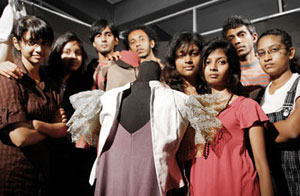
Small rectangular glasses with thick black rims accent Karen’s face, framed with brown plaited hair held together by a funky bright-blue hair-tie. Although she’s Principal, she’s keenly aware of everything going on at the school and is highly involved. She even knows most of the students by name, probably how she keeps track of all that’s going on. “I arrived here last September in the middle of design festival preparations and was a bit “wow!”” she laughs, “and I’ve found the only thing to do is just try and not go crazy!”

Up on the third floor, students in the fashion department are busy working on pieces they will submit for review and approval for the festival runway. The hangers along the walls of the workspace are neatly arranged with pieces already finished, but the tables are piled high with tonnes of colourful material of various textures and uses and students sit and stand around stitching, pinning, chatting laughing and some quite worried. Dilki, 2nd year fashion student has just been “blasted” and is painstakingly attaching hundreds of satin flowers to a bridal dress she has already finished. It’s the third day she’s doing this with the help of her friends, but she’s patient, because AOD requires “very very high quality” as Karen puts it. None of this is easy.

Anuradha and Lonali, who are part of a team of five students who’ve volunteered to work with local artisans on handloom craft projects, know this all too well. They’ve been spending 14-hour work-days in Gampaha working with nearly 70 artisans, coordinating teams as they take fresh takes in terms of colour and quality on the familiar local art. Some of the exhibits this work will produce include household items made from recycled thread and even denim-inspired handloom sarees! “Craft is no more about little old ladies sitting home and doing things because they have nothing better to do” Karen says, explaining how they’re aiming to contemporize national arts to give it a foothold and future in bigger markets.

And it’s not just handloom, they’ve got artisans from each and every province on the design festival agenda this year! They’ve also got elite international designers, advertising gurus, photographers and opinion leaders lined up to take part at the gala exhibitions and workshops that will take place at AOD and Mt. Lavinia Hotel. “We’re bringing everyone together on this to envision what Sri Lankan design can and will be in the next few years” Karen enthuses. It’s tonnes of work and everyone is so completely absorbed in it, gearing to give guests a blast of an experience, probably better than we’ve seen in the last two years..

“Who?” one girl questions when I ask her which floor the lobby is on – there is obviously only one thing on her mind. That same thing should most definitely be in your agenda for next week – especially since entrance is free!

United: One People

“Let us build a new Sri Lanka!” B. Priyathanushan of Vattapalai M.V. called out to his audience on the evening of October 29. Professionals, volunteers, well-wishers, teachers and parents gathered at the Sri Lanka Foundation Institute with students from Kandy, Mullaithivu, Vidutaltivu, Vishwamadu, Killinochchi and Mannar as they spoke, danced and sang in English, Sinhala and Tamil, to celebrate the launch of the Ekamuthu Oray Makkal (One United People) Unity Mission Trust (EOM-UMT).

Priyathanushan stood at the podium that night alongside two of his fellow students, to share his vision of a Sri Lanka that would recognize that “unity is strength” and step “beyond racial and religious differences” into a truly peaceful future.

EOM-UMT works to “foster and facilitate national unity, reconciliation, integration and healing amongst and between the children of the North, Wanni, South, Central and other areas of Sri Lanka”. The philosophy behind the trust is a simple one: that of friendship. “What we’re trying to do is create friendships between children of different communities, because it’s only personal relationships that can be translated into social change” explains trust coordinator Bertal Pinto-Jayawardane.

Although the trust is now officially established, EOM does not boast of grand beginnings.  It is another simply inspiring story of how one family, in its bid to help those in need, began approaching friends and work colleagues in order to collect whatever possible resources they could, to provide for those in need soon after the end of the war. Their genuine efforts to reach out soon grew and developed into what is now a source of true inspiration and encouragement to the younger generation of the North and East.

“I am extremely proud” S. Yasutha from Vishvamadu M.V. reiterated during her testimony, as she shared how her experiences at the EOM camps helped her learn, develop as a person, and most importantly, build friendships. Her generation is now stepping out of a war-torn life into something they have never experienced before and which we in other parts take for granted, and these friendships will, in time, prove to be strong links of support as they face challenges yet unknown. The testimonies shared that evening at the gala launch of the EOM-UMT were moving proof of what personal contact can do to remedy communal wounds that have festered for longer than three decades.

EOM-UMT operates on an inter-faith platform, giving primary importance to the recognition of the multi-ethnic and multi-religious nature of Sri Lankan society. Their main aims are to support the educational needs of the children in the war-affected areas by “developing reference libraries, providing school books and other requirements to support classroom studies and sports, and conducting small-scale infrastructure projects to facilitate schoolwork”.

So far, they have completed food, educational supplies and medical projects in Menik Farm, Chettikulam, Jaffna, Kayts, Vidutaltivu and Mannar a number of times over the last two years. Although this sounds like a good list of achievements for an informally organized group of “like-minded people” who see themselves simply as “concerned and caring citizens who love Sri Lanka”, their real victory – in the friendship business – is far greater. Photographs from the EOM Camps held in Colombo in December 2010 and Mullaithivu in June 2011 show tonnes of laughter and gleeful smile after gleeful smile, depicting students from Colombo, Kandy, Jaffna, Mannar and Mullaithivu as they “chill out”, play games and do creative stuff together.

“What have we achieved in 30 years of war?” S. Logeswaran of Vidyananda M.V., Mullaithivu asked that evening. “We have seen only death, maimed families and widows. Violence will only give us destruction. Only love can achieve anything.” Clichetic you may think, and uncannily strong for a teenager. But it is that very strength that testifies to its genuineness, for he speaks out of more experience than most of us.